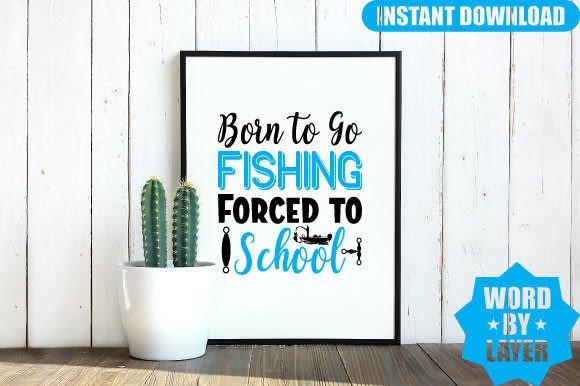
A Fishing Design That Lives Up to Its Name
As someone who’s worked with hundreds of embroidery files for client projects and my own small shop, I approach every new design with a practical eye. The goal isn’t just to admire a graphic on screen; it’s to visualize how it will look stitched out, how it will feel on a finished product, and how a customer or gift recipient will react to it. When I evaluate ‘Born to Go Fishing Forced to School Svg’, I’m thinking about its real-life application.
The Immediate Mood and Personality
First impressions matter, both for you as the maker and for your end buyer. This design has a distinct, playful personality. The theme is clear and relatable—a humorous, slightly rebellious take on a passion versus obligation. Visually, the layout suggests a good balance between the illustrative elements and the text. This isn’t a overly complex, dense graphic; it feels like it would translate well into a clean, readable embroidery design, creating a friendly and lighthearted mood. It naturally belongs to projects meant to evoke a smile: personalized gifts, casual apparel, or decor for someone with that specific hobby.
Where This Design Finds Its Best Home
Let’s walk through a real scenario. Imagine you’re preparing a custom order for a client who wants an embroidered tote bag for their father, a passionate angler. Or perhaps you’re stocking your Etsy shop with embroidered caps for a local fishing club. ‘Born to Go Fishing Forced to School Svg’ is a prime candidate.
It would perform well on:
- Casual apparel: Think sweatshirts, t-shirts, or aprons where the sentiment adds personalization.
- Functional items: Tote bags, pillow covers, or kitchen towels for a cabin or lake house.
- Gift-focused products: Embroidered on a baby onesie for a fishing-loving family, or on a blanket as a holiday gift.
- Small business merchandise: For a boutique selling niche outdoor-themed goods, this could be a branded patch on a hat.
The design’s appeal lies in its specificity. It won’t be for everyone, but for the right audience, it creates instant recognition and engagement, increasing the perceived value of your handmade product.
Points of Caution for a Perfect Stitch Out
No design is universally perfect for every application. With ‘Born to Go Fishing Forced to School Svg’, success depends on mindful execution. Based on my experience, here are situations where you should proceed carefully:
- Very small hoop sizes: If the design has tiny lettering or detailed corners, scaling it down too much for a small cap or baby item might compromise stitch clarity.
- Textured or stretchy fabrics: Without proper stabilizer, the definition on fabrics like fleece or certain knits could blur.
- Dark fabric backgrounds: Thread color contrast is crucial. A test stitch on scrap fabric is essential to ensure the chosen palette pops.
- Products requiring frequent washing: On items like kitchen towels, consider stitch density. A overly dense fill stitch might not wear as well as a simpler running stitch or applique approach.
These aren’t flaws of the design itself, but standard considerations for any embroidery project. They highlight the importance of treating the SVG file as a blueprint, not a guaranteed final product.
Impact on Your Craft and Business
Using a design like this isn’t just about the stitch; it’s about the entire finished product experience. When executed well, it enhances visual appeal through clear, thematic storytelling. It boosts customer trust because the product feels thoughtfully chosen, not generic. For a gift, its specificity makes it highly giftable. For your small shop, it contributes to brand consistency if you cater to a niche audience.
From a professional standpoint, it allows you to create printable mockups and digital product previews that accurately represent the final embroidered item, improving buyer engagement in your listings. However, a key note: always confirm the licensing terms provided with the ‘Born to Go Fishing Forced to School Svg’ file. Understanding whether it’s cleared for commercial embroidery projects, for selling finished items in your craft business, or only for personal use is a fundamental step before any production begins.
A Designer’s Practical Checklist Before Hooping
Before I commit any design to a client’s garment or my own shop inventory, I run through a quick mental list. For this fishing-themed SVG:
- Test on scrap fabric first: Use both a light and dark scrap to judge thread contrast and stitch integrity.
- Review the actual stitch density in your machine software: Look at the generated stitch file—are there areas that might be too dense for the chosen fabric?
- Confirm your intended hoop size is appropriate: Does the design scale cleanly to the size of your tote bag, pillow, or cap?
- Inspect small details: Pay attention to any intricate elements that might need adjustment.
- Use the proper stabilizer for your base material: This is non-negotiable for clarity on curved surfaces like caps or textured fabrics.
Remember, the product description states this is a digital download of SVG files. As an embroidery designer, you’ll be converting or using these as a basis for your machine embroidery file. The details like exact stitch count or machine compatibility come from that process and your equipment, not from the SVG itself. The design provides the graphic direction; your expertise provides the embroidered reality.
In the end, ‘Born to Go Fishing Forced to School Svg’ strikes me as a solid graphic asset for the right project. It has a clear personality that translates well into the crafts category. When paired with good embroidery technique, it can become a charming, conversation-starting piece on a finished product—whether that’s a gift, a personal item, or a piece of small shop merchandise. That’s the practical judgment: it’s a design that, with care, lives up to its name both in spirit and in stitch.